

Hello! If you've ever wondered what the currency is like in Paraguay, you're in the right place. Today I will tell you from my experience how Paraguay's currency works, how valuable it is and some tips that may be useful for you. if you plan to travel or live in this country.
The idea is that in the end you will be able to understand not only how much money is worth in Paraguay, but also how it is handled in everyday life. In addition to the values and currencies we are going to look at, I want you to know a little more about the local financial culture, how people here interact with money and some curiosities that may surprise you.
The Guarani currency: the oldest in Latin America
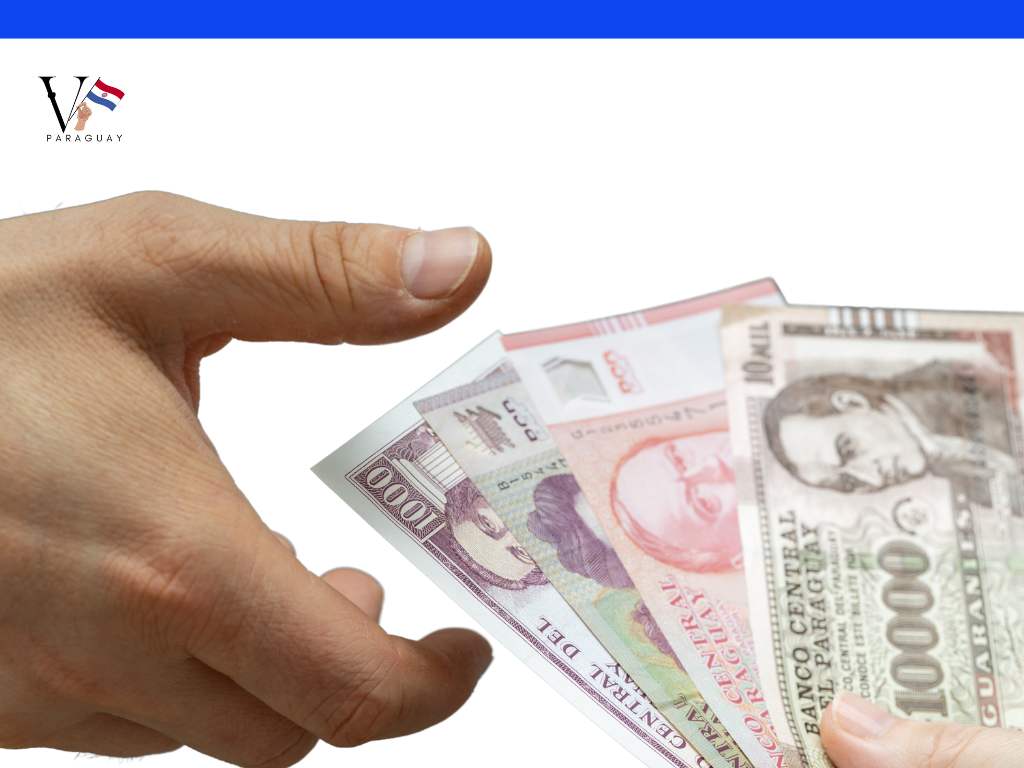
The guaraní is the official currency of Paraguay and, interestingly, it is also the second language In the country, the guaraní is the oldest currency in circulation in all of Latin America. Its value may seem impressive if you are used to currencies with fewer zeros. Here, being «millionaire» is pretty straightforward, although that doesn't mean you're rich. Here's why.
Coins in circulation
Paraguay has four main currencies, and each has its own «personality». Let's take a look at them and I will tell you about each one.
50 guaraníes: This currency is more symbolic than useful. Its value is so low that it is not even equivalent to one cent of a dollar or euro. Most people don't even bother to keep them. It is common to see them lying around, forgotten in drawers or on the floor. If you find one, you'll probably think: “Why do I keep it if it's not enough for anything?.
100 guaraníes: This coin has a little more value than the 50, but it is still not significant. People tend to hoard them because they have at least an occasional use. Of course, they don't want them very much either; they often end up lost in the change of the day.
500 guaraníes: Here we start talking about something more practical. It is worth about 7 cents, enough to start being useful for small purchases. It's that coin that, even though it's small, can save you when you need to complete payment for something. That's why people tend to hold on to it more.
1000 guaraníes: This is the most valuable of the Paraguayan coins. It used to be a banknote, but they decided to turn it into a coin to make it more resistant to daily use. It is worth about 14 cents and is one of the most valuable coins in Paraguay. more circulates. Why? Because it is practical, easy to use, and its value is sufficient for small purchases. This one has a place in everyone's pockets and purses.

Banknotes in circulation
Now let's move on to banknotes, which are the ones that really carry weight on a daily basis. These are the ones you are going to see most often and the ones that really matter when we talk about money in Paraguay.
2000 guaraníes: This is the smallest and most curious banknote. Made of plastic, it has a peculiar design that makes it quite resistant. Its value is around 26 cents. If you are European, it might remind you of the famous 500 euro bill, but don't get excited: its value is much more modest. Even so, it is very practical to pay for small things, such as a bus ticket or a snack.
5000 guaraníes: It is also made of plastic and has a simple design, although with some basic security measures, such as a small transparent window. Its value is about 69 cents, which makes it ideal for quick purchases, such as a soda or the famous cold tereré in a square. It is one of the most used bills in everyday life.
10,000 guaraníes: Here we go up a step. This is now a paper bill worth approximately $1.38. In addition to its practical value, it has more advanced security measures, such as touch marks and light-visible stripes. It is very common in local commerce, whether to pay for a quick lunch or a couple of products at the supermarket.
20,000 guaraníes: This bill is very popular because it is equivalent to about $2.76, a significant amount to cover several basic needs. It is clearer and has details such as holographic stripes and watermarks that make it more secure. With this bill you can pay for something bigger, like a couple of movie tickets or a good meal at a fonda.
50,000 guaraníes: Here we are already talking about a ticket that gives you room to indulge yourself. With an approximate value of $6.92, this bill is perfect for enjoying a nice dinner at a local restaurant or filling up your cart at the supermarket. It is a favorite when it comes to larger payments.
100,000 guaraníes: The «king» of Paraguayan banknotes. It is worth about $13.84, enough to cover all the expenses of a full day, from breakfast to a night out. It is the largest banknote and, although it is not so common in everyone's pocket, it is always welcome. With its advanced security measures, such as metallic threads and hidden details, it is an example that practicality can also be elegant.

Money management in Paraguay
Now that you know the coins and banknotes, let's get down to the interesting part: how they are used and the peculiarities of money management in Paraguay.
In Paraguay, cash is still king, especially outside the big cities. Although in Asunción and other urban areas it is increasingly common to use debit and credit cards, in markets, small stores and even on public transport, the physical guaraní is the most widely accepted form of payment.
Rounding is common
The small coins, such as those of 50 o 100 guaraníes, are so insignificant in value which, in practice, are often not even used. This has led to the fact that, in Paraguay, it is common for prices to be round up. For example, if a cab costs 6900 guaraníes, you will most likely end up paying for 7000. This type of rounding is also common in supermarkets, kiosks, service stations and virtually any trade, especially when the total amount is not exact.
This dynamic means that lower denomination coins are almost always left behind. relegated. In fact, they often end up forgotten in some corner of the house, in a drawer or at the bottom of a wallet. For many, the effort to carry and use them is not worth it, as they make no real difference in everyday transactions. It is even common to find these coins lying on the street o abandoned in counters because, for most people, their value is more symbolic than practical.
The rounding also has its practical side, since it simplifies the transactions and streamlines payments, especially in places where there are no electronic cashing systems and everything is handled in cash. For example, in the markets o street stalls, It is easier to round to a closed figure than to worry about getting coins of the same denomination. 50 o 100 guaraníes. However, this custom can also benefit the sellers, The rounding of the price is generally in favor of the retailer.
Cash culture
Although credit and debit cards are gaining popularity in Paraguay, cash is still the absolute king, especially in everyday life. If you decide to visit markets, small stores, street stalls or even take a cab or mototaxi, you will most likely need cash on hand, as many of these places do not accept electronic payments. The cash economy is so prevalent that even in some smaller restaurants and certain established businesses, the use of cards may be limited or subject to a minimum purchase amount.
For this reason, familiarizing yourself with the bills is essential. At first, it may be a little confusing to handle so many zeros in the denominations, especially if you come from a country with a more «simplified». For example, paying 50,000 guaraníes for lunch may sound exorbitant if you are not used to it, but in reality it is equivalent to less than 7 dollars. The same goes for larger bills, such as the 100,000 guaraníes, which although it sounds like a lot, is only equivalent to about US$13.

How stable is Guarani?
Like many other currencies in Latin America, the guarani has experienced a loss of value over time due to factors such as inflation and the economic fluctuations. Although this is a common phenomenon in many emerging economies, it is important to note that the guarani has not suffered from extreme devaluations and no sharp falls as in other countries in the region. Instead of a drastic devaluation, the guarani has experienced a gradual loss of purchasing power, reflecting the dynamics of the national economy over the years.
One of the most noteworthy aspects of this evolution is the behavior of the Guarani language in relation to the US dollar, which has been an important reference in the country. From 2019, the value of the dollar has been increasing against Guarani, going from approximately 6210 guaraníes per dollar to about 7300 guaraníes in 2024
Is it better to save in guaraníes or in another currency?
If you are thinking about save a good amount of money in Paraguay, I would recommend you to do it in dollars or euros. These coins are much more stable than Guarani, and over time they tend to to better maintain its value. The guarani, like all local currencies, can be affected by inflation, which means that your money could lose purchasing power over time. Therefore, keeping your savings in a strong currency such as the dollar is a way to protect your money from local economic fluctuations.
Although the Euro is also an option in Paraguay, it has recently lost some value due to the economic uncertainty affecting Europe. This does not mean that it is a bad option for saving, but if you are looking for more money, it is a good option. long-term stability, The dollar is still the best alternative, especially if you are thinking of savings that will last through the years.
It is true that, although the guarani is the currency we use every day, it is not always the best option for accumulating savings. If your goal is to have a cushion of money that really retains its value, then betting on stronger currencies will give you that peace of mind. In the end, saving in dollars or euros allows you to have a little more peace of mind, knowing that your money is protected against the ups and downs of the local economy.
But the guaraní is, without a doubt, the currency we use on a daily basis in Paraguay. It's the one you need to make most everyday purchases, from a coffee on the corner to your lunch at the market. It is important to have guaraníes on hand for anything that involves small or daily transactions. In addition, keeping some guaraníes is always useful for emergencies or unexpected expenses, In many small places, cabs or stores, the use of cash in guaraníes is the most common. So, even if it is not the strongest currency to save, having guaraníes available for your daily needs is absolutely necessary and practical.
We help you to...
OBTAIN PARAGUAYAN RESIDENCYY
Open a bank account in Paraguay
If you are thinking of living in Paraguay, opening a bank account is an important step. Here's how it works:
- Accounts in guaraníesTo open a basic account, you need the cédula Paraguayan, which is the local identity document. This implies that you must first obtain residency in the country. Once you have the cédula, opening an account is simple, especially with the digital banks that have gained popularity in recent years.
- Dollar accountsThese require more requirements, such as proof of income. However, they can be a good option if you want to protect your money from inflation.
Practical tips for managing money in Paraguay
- Familiarize yourself with banknotesAt the beginning, zeros can be confusing. Learn to distinguish them to avoid mistakes or possible scams.
- Use cash in small placesAlthough many establishments accept cards, small businesses prefer cash.
- Beware of currency exchangeExchange houses offer different rates depending on the currency. Do your research before exchanging large amounts.
Final reflection
In Paraguay, you can feel «millionaire» easily thanks to the Guarani system of zeros, but that does not mean that it is cheaper to live here. The important thing is to understand how the local money works and adapt to its peculiarities. If you are planning to move or visit the country, my advice is to arrive with an open mind, ready to learn and enjoy the little surprises this economy has to offer.
I hope this article has given you a clear and practical overview of what money is like in Paraguay.
If you want to know more about Paraguay life, banks or foreign card operation, remember that we provide a service of consultancy .

Greate article. Keep posting such kind of info on your page.
Im really impressed by your blog.
Hey there, You've performed a fantastic job. I'll
certainly digg it and in my view suggest to my friends.
I'm confident they'll be benefited from this web site.